Reading list

Books

The texts behind the science — and the ones asking harder questions about what we do with it.

Behavioural Science

The experimental tradition — the studies, the findings, and the people who proved humans are not rational.

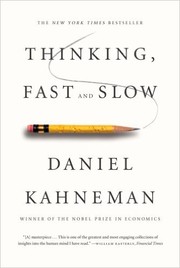
Cover of Thinking, Fast and Slow
Daniel Kahneman 2011

Thinking, Fast and Slow

A definitive account of how fast, intuitive thinking and slower, deliberate reasoning shape the judgements we make.

Why it's here

Many of the principles found in behavioural science can be traced back to the work of Kahneman and Tversky, whose research began in the 1970s.

Cover of Noise
Daniel Kahneman, Olivier Sibony & Cass Sunstein 2021

Noise

Noise book explores how judgement is not just influenced by bias but with "noise"— random variability that causes wildly inconsistent decisions.

Why it's here

Kahneman's later follow-up to Thinking, Fast and Slow, Noise is the hidden twin of bias. It is harder to see and can be equally impactful to the decision making process.

Cover of Behavioural Insights
Michael Hallsworth & Elspeth Kirkman 2020

Behavioural Insights

A rigorous, practical framework for applying behavioural science in the real world. The authors appeal to moving away from nudges and towards a more concrete, systematic theory of behavioural science.

Why it's here

Hallsworth and Kirkman distil a decade of applied work in the BIT into a framework that is both scientifically grounded and immediately usable.

Cover of Predictably Irrational
Dan Ariely 2008

Predictably Irrational

A series of clever (and sometimes unusual) experiments revealing how irrational our decisions are.

Why it's here

Ariely's explores a wide range of behaviours through his own work and research and does so with humour and clrarity. A great introduction to the quirks of human decision-making.

Cover of The Undoing Project
Michael Lewis 2016

The Undoing Project

The story of Daniel Kahneman and Amos Tversky — the friendship and intellectual partnership that created behavioural science.

Why it's here

The human story behind the science. Lewis makes the ideas visceral by grounding them in two lives.

Cover of The Power of Habit
Charles Duhigg 2012

The Power of Habit

How habits form, how they can be changed, and how companies have learned to engineer them at scale.

Why it's here

Anchored in the neuroscience of the basal ganglia and habit loops. Duhigg traces the line from laboratory to commercial manipulation with uncomfortable precision.

Cover of The Black Swan
Nassim Nicholas Taleb 2007

The Black Swan

Explores how rare, unpredictable events shape history, markets and knowledge — and why humans systematically underestimate their impact.

Why it's here

Taleb dismantles our tendency to construct tidy explanations after the fact. Essential for understanding narrative fallacy and the limits of prediction.

Cover of Fooled by Randomness
Nassim Nicholas Taleb 2005

Fooled by Randomness

Examines how randomness and luck are mistaken for skill, particularly in financial markets and decision-making under uncertainty.

Why it's here

A foundational critique of how humans misinterpret probability. Sharpens intuition for risk, variance and survivorship bias.

Cover of Engaged
Amy Bucher 2020

Engaged

A practical framework for designing behaviour change using behavioural science, focusing on motivation, ability and prompts.

Why it's here

Bridges theory and product/application. One of the clearer operationalisations of behaviour change design.

Cover of The Power of Experiments
Michael Luca & Max H. Bazerman 2020

The Power of Experiments

Explains how organisations use randomised experiments to improve decisions, products and policies.

Why it's here

Shows how behavioural insights are validated in practice. Strong emphasis on causal inference and real-world testing.

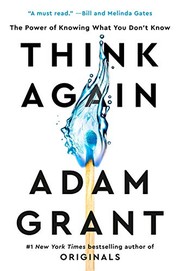
Cover of Think Again
Adam Grant 2021

Think Again

Explores the value of rethinking beliefs and updating views in light of new evidence.

Why it's here

Less technical, but relevant to cognitive flexibility and belief updating — areas often neglected in bias-focused work.

Behavioural Economics

Where psychology meets markets — the discipline that proved humans are not the rational actors economics assumed.

Cover of Misbehaving
Richard Thaler 2015

Misbehaving

The story of behavioural economics told from the inside — how a rogue discipline overturned decades of rational-actor orthodoxy.

Why it's here

Thaler shows how "irrelevant" factors like fairness, loss aversion and mental accounting drive real economic decisions. Warm, readable, essential.

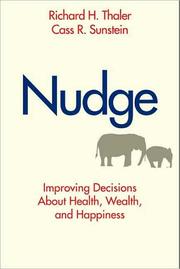
Cover of Nudge
Richard Thaler & Cass Sunstein 2008

Nudge

The founding text of libertarian paternalism — the idea that choice architecture can steer people toward better outcomes without restricting freedom.

Why it's here

The policy application of behavioural economics. Essential context for why governments took this seriously — and for the critiques that followed.

Cover of Sludge
Cass Sunstein 2021

Sludge

The dark side of nudge — how excessive friction, paperwork and administrative burden is used to prevent people accessing what they are entitled to.

Why it's here

The necessary counterweight to nudge theory. Where nudge asks what frictions can help, Sludge asks what frictions are being deliberately weaponised against people.

Cover of The Choice Factory
Richard Shotton 2018

The Choice Factory

Twenty-five behavioural biases that influence purchase decisions, illustrated with advertising case studies.

Why it's here

Shotton translates academic psychology into commercial practice with unsettling clarity. A field guide to what you're being subjected to.

Cover of The Paradox of Choice
Barry Schwartz 2005

The Paradox of Choice

Argues that excessive choice leads to anxiety, regret and decision paralysis rather than greater satisfaction.

Why it's here

A core critique of classical assumptions that more choice improves welfare. Important for understanding decision overload.

Cover of Irrational Exuberance
Robert J. Shiller 2020

Irrational Exuberance

Examines speculative bubbles in financial markets, driven by psychological and social dynamics rather than fundamentals.

Why it's here

Extends behavioural economics into macro markets. Demonstrates how collective irrationality scales.

Cover of The New Economics of Human Behavior
Mariano Tommasi 2008

The New Economics of Human Behavior

Introduces an integrated framework combining economics, psychology and political economy to explain real-world decision-making.

Why it's here

More theoretical than most in this list. Useful for situating behavioural economics within broader economic modelling.

Neuroscience

The biological and neural basis of behaviour — from the brainstem to culture.

Cover of Behave
Robert Sapolsky 2017

Behave

The biology of human behaviour at its best and worst — from neurons to culture, examining why we do what we do.

Why it's here

The deepest account of what drives human action. Puts behavioural economics in its proper context: the product of biology, culture and circumstance, not free-floating rational choice.

Cover of Determined
Robert Sapolsky 2023

Determined

A case that free will is an illusion — that every human decision is the product of prior biological and environmental causes.

Why it's here

Sapolsky's most radical argument. Essential reading for anyone who wants to take seriously the question of what 'choice' actually means.

Neuroeconomics

Where the brain meets the market — the science of how neural systems generate economic decisions.

Cover of Decisions, Uncertainty, and the Brain
Paul Glimcher 2003

Decisions, Uncertainty, and the Brain

The foundational text of neuroeconomics — how neuroscience, psychology and economics can be unified into a single theory of decision-making.

Why it's here

Glimcher effectively created neuroeconomics as a discipline. Dense but essential for understanding the neural machinery behind the biases this platform documents.

Cover of Neuroeconomics
Peter Politser 2008

Neuroeconomics

An accessible guide to the new science of decision-making — bridging neuroscience, psychology and economics for a general audience.

Why it's here

The clearest introduction to neuroeconomics available. Politser translates the neural hardware of choice into terms anyone can act on.

Economics

The broader structures within which behaviour plays out — markets, inequality, poverty and power.

Cover of Poor Economics
Abhijit Banerjee & Esther Duflo 2011

Poor Economics

A radical rethinking of the economics of poverty — based on field experiments that reveal how the poor actually make decisions.

Why it's here

Grounds behavioural economics in the sharpest possible context: survival. The decision-making of people under extreme constraint exposes the limits of rational actor models better than any lab study.

Cover of Good Economics for Hard Times
Abhijit Banerjee & Esther Duflo 2019

Good Economics for Hard Times

Two Nobel laureates on what economics actually knows — and doesn't — about migration, inequality, trade and growth.

Why it's here

A model of intellectual humility and moral urgency held at once. Grounds behavioural economics in the larger project of evidence-based policy.

Cover of Weapons of Math Destruction
Cathy O'Neil 2016

Weapons of Math Destruction

How big data and algorithms amplify inequality — targeting the vulnerable with predatory products while appearing objective.

Why it's here

Behavioural exploitation scaled through data. The feedback loops O'Neil describes are the industrial version of what this platform documents at the human level.